Not Norman Goes E with Nook
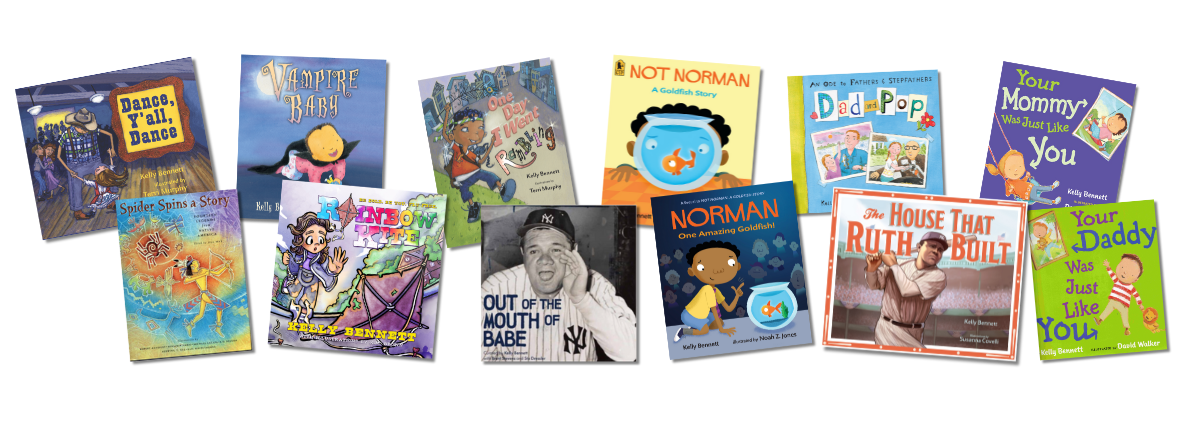
Not Norman, A Goldfish Story is moving into the techno world. Our favorite goldfish story has been chosen as one of the first books to be published through Barnes & Noble's NOOK Kids color e-reader. According to the folks at Candlewick Press, “The electronic version will be very true to the physical edition, maintaining the look of the spreads and the feel of the page turns. There won't be any audio, animation, or other enhancements; the only change is that readers will be able to click on the text in order to zoom in and make it easier to read.”
If you’d like to experience Nook books for kids click onto Barnes and Nobles website: Nook Color for Kids. As part of the promotion, for a time NOOK Kids B&N is allowing customers to sample Not Norman, A Goldfish Story "the E-Book" on their computers.
Thanks Giving
give thanks for all I have—including the ability to write, the mind to imagine, the time to dream, and the desire to strive for good sentences, one after another after another…
I used to think author photographs on book jackets were stony-faced and black and white to make readers think the writers were seriously brilliant, thus implying their work was brilliant and deserved reading. Now, after a few decades spent writing (with varied success) I think those photos are printed in shades of gray because the authors in them are gray—morose—miserable even, because writing is hard. Even humorist, columnist, satirist, Dave Barry, author of more than 30 books and Pulitzer Prize winner in journalism, a guy I imagined spent his days chuckling as he clicked away on his keyboard, finds it hard. The Summer 2010 Author’s Guild Bulletin published a snippet from The New Your Times Magazine interview in which Barry described his writing routine:
“Get Coffee. Stare at screen. Write a bunch of things that aren’t any good. Then comes that moment when I’ll say, ‘That’s still not any good.’”
Am there…do that! Which begs the burning question: If writing is so bloody hard, why do it?
In the same issue of the AG Bulletin, Lisa Grunwald, suspected author of Primary Colors, actual author of The Irresistible Henry House (named the “Best Book of 2010-so far”) answered the question:
“Some days, it’s torture,” she said. “But just that business of writing a good sentence—it’s authentically joyful.”
It’s a joy to devote this day to focusing on what is right in my life, to recognize and give thanks for all I have—including the ability to write, the mind to imagine, the time to dream, and the desire to strive for good sentences, one after another after another…
Happy Thanksgiving!
Life As We Knew It
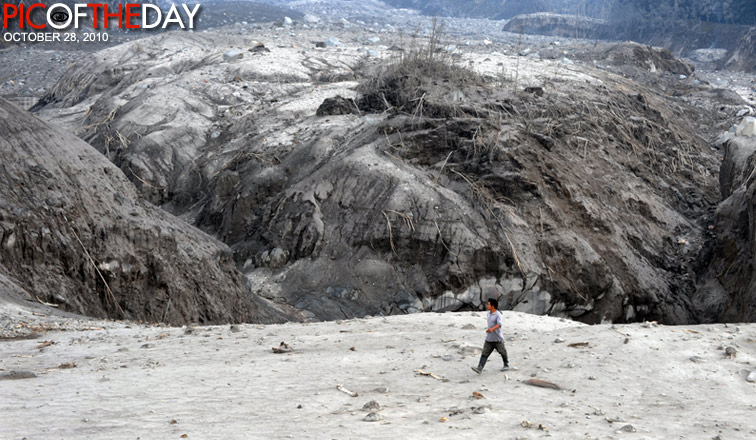
Eruptions at Mount Merapi are still continuing and with increasing intensity.
It’s Friday, Nov 5, 2010. A warm bright day in Jakarta. As I usually do, after waking I called folks back home, made a cup of coffee, and sat down to check e-mail. As it usually does, my e-mail brought some good stuff, and some issues for me to grumble about. Then I read the news:
“Eruptions at Mount Merapi are still continuing and with increasing intensity. And it would seem that the recent earthquake off West Sumatra may have also contributed to increased activity of other volcanoes – with some 19 out of 68 volcanoes in Indonesia having been given yellow status – that is, a heightened level of alert due to escalating activity – including Anak Krakatau. Authorities in response have declared a no-go zone within 2 kilometers of Anak Krakatau. Meanwhile relief efforts have been hindered at the Mentawai Islands, West Sumatra due to bad weather.”
Here I am focusing on my petty issues when a few hundred miles away—the distance from San Diego to LA or New Orleans to Houston—volcanoes, poisonous gas billowing, lava, rock and ash spewing volcanoes are erupting. The caretaker of the mountains spirit is dead, along with at least 92 others. A friend who lives about 40 km from Merapi said "the ash is falling like snow."
As events often do, they brought to mind a book: Life As We Knew It by Susan Pfeiffer. This book, with its tsunamis, rising water, erupting volcanoes, storms, devastation and deaths did to me what Orson Wells’ broadcast of War of the Worlds must have done to listeners during its day. It terrified me—and captivated me—and is still haunting me—more with every day’s news. Written as Pennsylvania teen Miranda’s diary, this futuristic-cautionary tale is a real-time account of Miranda and her family’s struggle to survive after an asteroid knocks the moon off course. Pfeiffer’s Miranda makes my bitch, moan, and complaining feel normal. Even after these worlds collide, Miranda sweats the small stuff, fights with her mom, longs for romance. I like that in her.
News like this, books like this, make it hard for me to go about my business. It might be different if I were a health service provider or provided a service. But I’m not and I don’t. I write. And when I’m not writing I plant flowers, make frivolous hats, organize parties, or go, as I am scheduled to today, for a mani-pedi and cream bath. It’s difficult to carry-on with such blatantly hedonistic pursuits in the midst of so much horror. It makes me feel like Nero.
So, instead of doing what I usually do, I wandered around the house wondering: what should I be doing?
Should we change who we are because what we are isn't noble or necessary? Should a cat stop being a cat?
Then I remembered the 2001 holiday season. Some society maven (maybe the breakfast cereal heiress?) was thrashed by the media for holding her annual holiday fete that year. Popular opinion dictated that in the Wake of the 911 Twin Tower attacks no one should make merry—especially not to the tune of U.S. millions. Her response (I paraphrase): You give your way; I give mine.” She then published an itemized bill for the party and suggested critics consider how many people she is employing and how, by throwing the party, she was doing her part to bolster the suffering economy.
She had a point. Maybe the best thing I can do, especially considering what I do, is follow her example. And, as Sam told the radio talk show host when she asked how he was going to get over the death of his wife, Maggie:
“[I’m going to]get out of bed every morning and breathe in and out all day.
And after a while I won't have to remind myself to do it.
And then after a while I won't remember how perfect things were." - script from Sleepless In Seattle
Everything I know About Writing I Learned from a Musical
From Gypsy, the musical based on the life of infamous Burlesque stripper, Gypsy Rose Lee, (Styne, Sondheim & Laurent 1962) I learned “You Gotta Have a Gimmick.” Translation: What’s your hook? If you can’t tell me in one sentence what your story is about, then you aren’t sure….and make it sticky (ala The Tipping Point)! From My Fair Lady, based on Bernard Shaw’s Pygmalion, (Lerner and Lowe 1956) I learned “Now once again, Eliza, where does it rain?/ On the plain! On the plain!/And where’s that soggy plain?/In Spain! In Spain” and “Ay not I, O not Ow, Don't say "Rine," say "Rain.” Translation: Practice makes perfect and grammar counts.
From Mary Poppins (Richard and Robert Sherman 1964) I learned how to deal with critique and rejection letters: “A spoon full of sugar helps the medicine go down…”
But the most important lesson of all, the life lesson that has helped me focus, direct my energies, and define what I want to achieve through my writing and for my life came from The Music Man (Meridith Willson, 1957). Professor Harold Hill, a smooth-talking, womanizing, flim-flam man cons the “good people” of River City, Iowa, into buying band instruments and uniforms for their boys under the guise of forming a “town band.” Professor Hill (Robert Preston in the movie)—who can’t read music or play an instrument—instructs the boys using “The Think System,” asserting that music can be learned just by thinking it.
At the climax of the show, a moment that still stops and then warms my heart, the boys, in their ill-fitting uniforms and wielding their shiny new instruments, are assembled in the gym. The tar is hot, a bag of feathers handy....Love interest, Marion the Librarian (Shirley Jones in the movie version) snaps a pointer in half and hands it to the handcuffed Professor. It’s do or be done to time for good old Harold.
Professor Hill raises the pointer, cocks his head, squeezes his eyes closed and implores: “Think, boys, think!”
And they do. Every boy in that room blows, bangs, or beats his instrument with every drop of musicality he has. And I’ll be danged if they don't make music! It’s not perfect; the band is far from on key or in time, but those boys play music! Before our eyes the motley crew become a shining, high-stepping brass band—76 Trombones strong. “That’s my Barney!” one dad calls out (our family’s ataboy!)
The current name for it is the “Art of Abundance” defined as: “ The secret to getting the goals you set begins with setting an intention -- a powerful tool that generates results because it reprograms your brain to see the truth: That you are easily and effortlessly accomplishing what you desire.”Oprah touts it, preaches it, devotes programs to it. Books like The Secret and The Passion Test teach it. Before all of them, Meridith Willson had it (it may have taken 8 years and 30 revisions, but he proved it with The Music Man.): The Think System.
You can do it! As sure as those boys played those instruments, you can do it--whatever your IT is. You can write that poem, that play, that book! You can achieve everything you want…but first…first….first: You have to Think It.
To paraphrase Professor Harold Hill “Think, Writers. Think!”
When Are You Going to Write an ADULT book?
The capitalizd "ADULT" is theirs: The people who smirk when I say I write "children's books" and think I'm the worst sort of underachiever when I say I'm good for about 750 words--no more, and often, no less (not good, as picture book publishers seem to want younger and shorter). And, no, my ambition is not to write the next great literary novel, or the next Harry Potter-ish zillion-seller. I write mostly picture books (and recently, chapter books). Books for children--children between the ages of 0 and 9, yeah, those little guys. The ones that can't read well, or can't read at all... yet. Because inside--regardless of what this blousy, saggy, wrinkled body I inhabit may imply--I am a child aged somewhere between 0 and 9. I realized today, as I walked all alone down some unknown road in an unfamiliar city--feeling little, lost, lonely and sad--that (to paraphrase my own text) no matter how big I get or how old I get, I will probably always be a child.
I want what every child wants: love, acceptance, companionship, and reassurance that whatever I do or don't do, at the end of the day someone fearless and reliable will make sure I am cozily tucked in. That I have everything I need--including a glass of water and lovies. That, those mean, scary under-the-bed spookies have all been chased away. And that, at the end of it all, no matter how ugly, or mean, or hard it seems--everything is going to come out just fine.
Don't you?
Where to Begin? ‘Tis A Puzzlement
I have a brilliant idea for a story. As soon as I figure out where to begin I’m going to write it. However…knowing when and which window to climb through to enter a story—‘tis a puzzlement. Recently, I visited the Hampton Court Maze outside of London (Henry the 8th old place, William and Mary's too). Don't ask me why as I'm not much for puzzles. Sure, if someone dumps a jigsaw puzzle on the table, I’ll work at fitting the pieces together (especially if it’s dumped on a coffee table during sports or the news). But, not if it’s one of those edgeless or upside down puzzles…and not if you expect me to work from the inside out! If I’m going to work a puzzle, I’m going to work it my way-- by fitting the edges together first.
Hampton Court Maze begins at a neatly trimmed archway in the hedge beckoning “Begin Here” and I did. So I’m in this centuries old Maze. I’m wandering, doubling back, turning and returning on a quest to find the middle. It wasn’t fun. It was frustrating, irritating, and a little frightening. From somewhere in the middle of the Maze, children shouted “Middle! I found Middle!” “I’m in the middle” “Come and get me!” which only irritated me more. I caught flickers of bright colors as they ran and jumped and rejoiced—in the middle! I wanted to be “in the middle” real bad…Or I wanted to quit. (What if I’m still wandering around in here lost at closing time? Will someone rescue me? Send a helicopter?). And it dawned on me: Being lost in a Maze is like writing.

I don’t do aimless. I am not a merry wanderer—no matter how bright the day, how green the grass, how sweetly scented the breeze. Nor do I like wandering around an idea, webbing, character sketching, brainstorming or any other of those “where to begin” writing exercises. I tire too easily. After all that, by the time I’ve found the beginning, I’m too worn out to take the journey.
When I finally found the Maze’s Center, I snapped a photo to prove it, and then started back out. The way out wasn’t any easier than the way in. (I had not pulled a Gretel and laid a trail to follow.) But it was heaps more fun. Because I knew, as sure as I had entered and found the center, that I could find the way out. It’s like that with writing, too. Once a neatly trimmed beginning has lured me inside I’m raring to go. I may not enjoy it, but I’ll wander, follow turns and twists, double back, whatever it takes to get to the end.
Until then I sit and wait, like a roosting hen beneath a Hampton Court Maze hedgerow, perched on my story idea, keeping it warm, turning it regularly, trusting that when the time is right, the perfect beginning will poke me in the butt.

BLAH BLAH BLAH or Bucket List
I want….I want….I want. Career-wise, life-wise I want so much. Don’t you? Life-wise my wants are easy to list: health, wealth and happiness for me and my loved ones. Not too much to wish for is it?
Career-wise, especially when the career I am pursuing is that of a children’s book author, listing my wants is not so easy. I say, “I want to be a successful children’s book author.” But when I’m asked what I mean by “successful” a whole lot of blah blah blah comes out. Why is that?
Is it because I don't know? Or because I'm hesitant to say...to put it out there...to be so bold. Maybe. Maybe I have never taken the time to define "success" for myself. Or, maybe I have never been able to mustered up the courage to clearly define successful for myself. Courage--it definitely takes courage!
Ask a little kid: What do you want to be when you grow up?
Ballerina! Movie Star! Rock Star! Doctor! Astronaut! President! Superman! Ice Cream Girl! they respond, listing infinite choices and possiblities.
We don’t say, “fat chance” or “who the heck do you think you are wanting to be president?” or “be realistic.” We say: “Go for it!”
Not so for us big guys. It seems the older, more mature, more responsible we are the less willing we are to speak up for ourselves, to dare to define “it.”
How can we “go for it” when we won’t let ourselves admit what “it” is?
Dancing With The Stars co-host, Brooke Burke, started her career as a pretzel maker in a mall shop, and look at her now! Last week, Oprah asked Brooke how she went from a contestant on the show to hosting it. Brooke shared how she had created a Bucket List of desires for herself, which she shared, listed, twittered about. She said she had to let herself be vulnerable, to “put it out there” without worrying that she was sounding grabby, or being unrealistic. And to be willing to say to the world, “This is what I want. And, yes, I am going to go for it!” Brooke’s Bucket List included Co-hosting Dancing With the Stars and Being a guest on Oprah! She put it out there. Brooke risked being scoffed at, shot down, teased, being told “fat chance” and “who the heck do you think you are?” And, as Brooke said, “what’s the worst that could happen?”
Following Brooke’s example, I am daring me to create a career bucket list:
What do I want to be when I grow up? A successful children’s book author!
To me, Kelly Goldman Bennett, “Successful Children’s Book Author” means:
I will write picture books and chapter book manuscripts editors want to publish.
My books will receive starred reviews.
My books will receive awards and be on reading lists.
My books will be featured “all school” and “all city” reads.
Children, parents, librarians and teachers will send me fan mail.
Editors will seek me out; ask me to write for them.
Conference Coordinators will invite me to speak.
All this and more!
Your turn: What’s on your bucket list? I dare you!
Wedding Bells Jakarta-Style
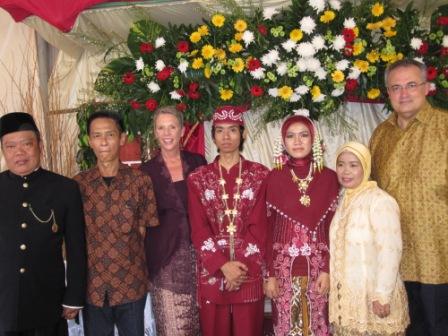
I’ve shared so much of our Jakarta life: woes about my pond; frustration over the traffic and miscommunication; sorrows, as with Suharti’s death last month. It’s fitting and especially joyful to share glad tidings: This weekend Linda Hermawati, Rusnati and Rohemon’s oldest daughter, married Agung Iskander. As is the custom, the wedding was a three-day affair, beginning with a Muslim ceremony on Friday and culminating in a Javanese-style reception on Sunday to which Curtis and I were invited. Rusnati's mother and father came from Cirebon for the wedding. Rohemon, an only child, has his cousins there. (Agung's family was there as well, I just didn't get a photo of them)
Unlike Western weddings, which are more about getting things ready for the big event, Indonesian weddings are about readying the bride and groom for this life changing event. For 5 nights before the wedding, the bride was prepared for the ceremony. Linda prayed and fasted during the day. She could not eat certain food including chicken or eggs. Each evening her mother (and other women in the family) washed Linda with an herbal scrub to make her skin soft and sweet-smelling.
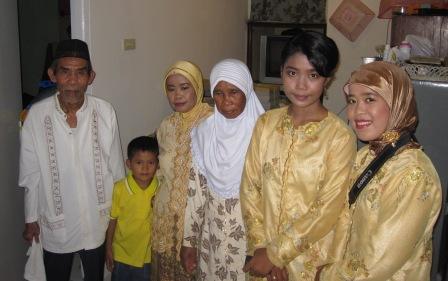
Sunday’s reception was held at Rusnati and Rohemon’s home. The driveway beside the house was completely tented and festooned with flowers and decorations.

A dais with chairs for the bridal party, the parents of the bride, bride and groom, and parents of the groom stood in that order to greet each guest. It is customary to hold each person’s hands between yours during the greeting. Guests bless the couple by saying “selamat berbahagia” welcome/best wishes for your wedding. The first wedding we attended, our Driver, Aan and social guru, coached Curtis and I on the proper pronunciation of that phrase. We said it to everyone we met that day, not realizing we were wishing each of them happiness at upon their wedding.
The wedding party spends the entire reception on the raised dais, at the ready for photographs and to greet the next guests, and the next, and the next. Some receptions last 2 hours, some all evening. It is no wonder that Javanese wedding parties don’t smile. (Actually, smiling for photos is a relatively new practice in Indonesian, popularized by youngsters snapping and swapping pics via Handphone.) Not only do older Indonesians not smile for photos, many will not look at the camera and some refuse to have their pictures taken. Perhaps in the style of Native Americans, they believe the process of taking a photo takes part of their spirit?
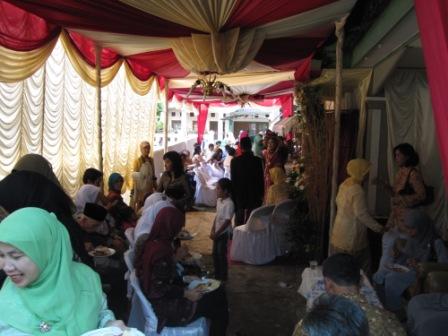
Unlike Western weddings, there’s no dancing, no toasting, no speeches by the family—at least not at the reception. (I don’t know what happens at the other wedding events as I’ve never been.) At large, hotel receptions there are constant announcements over a microphone. Guests are announced as they approach the wedding party; family members are announced as they enter the room, co-workers, friends and family members are called up to take photos with the wedding party as per a pre-set list. All this announcing mixed with twangy-clangy gamelan music and caterwauling by traditional singers is so loud it makes polite conversation impossible, so everyone has to yell…and the decibel level rises.
Mercifully, Linda and Agung spared us from that. The tone of their wedding was friendly, a pleasant blend of eating, drinking, chattering, children playing.
It was an honor for Curtis and me to share this joyous occasion with Rusnati, Rohemon and their families and friends.
Selamat Berbahagia, Linda and Agung!